

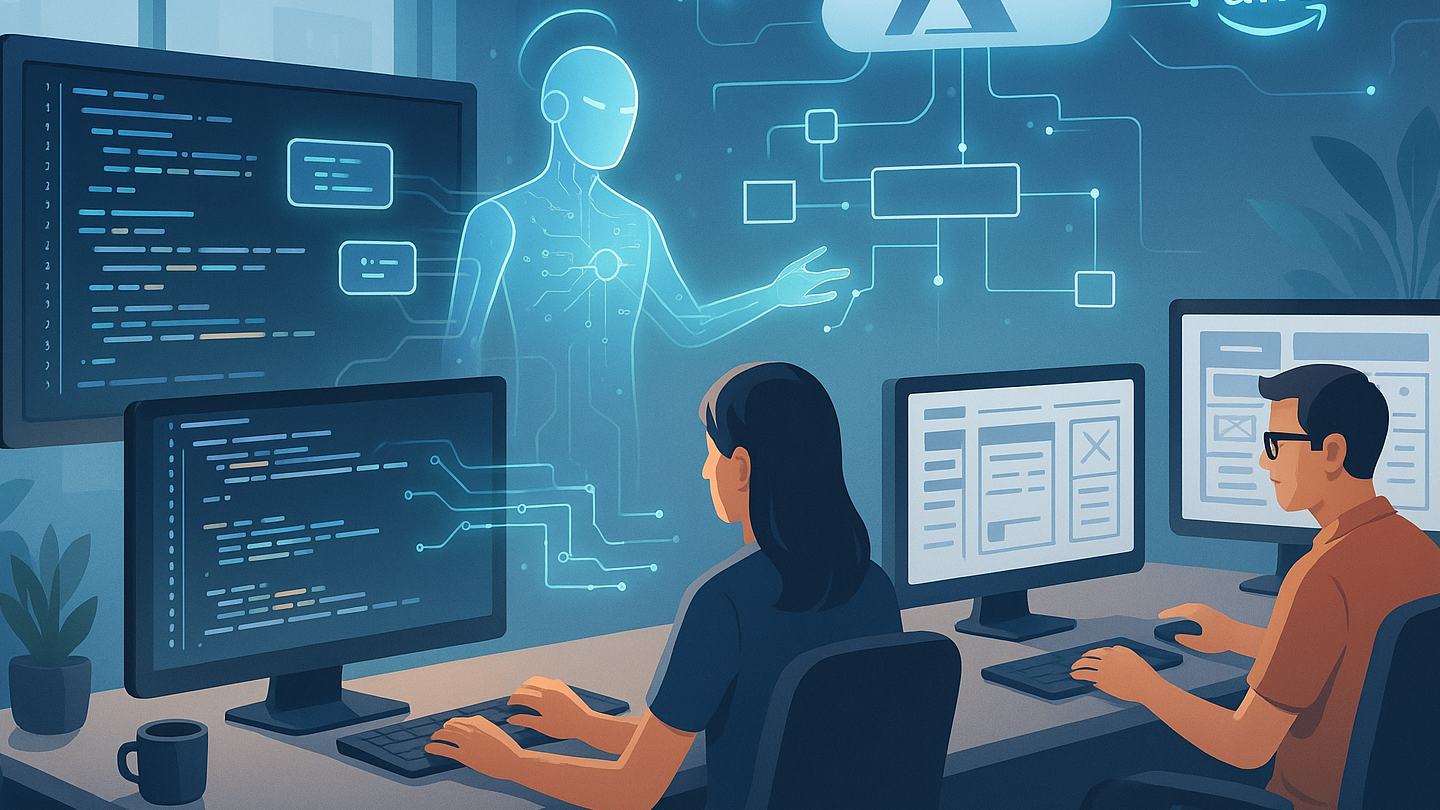
The promise of artificial intelligence in software development has moved well beyond code autocompletion and flashy demos. For modern tech leaders, AI now offers tangible, repeatable gains across the entire development lifecycle—cutting weeks of work down to hours, augmenting team productivity, and unlocking new efficiencies in design, deployment, and delivery.
In this article, we will unpack the top ways AI is transforming our daily development workflows here at Ascendle. From initial architecture planning to final pull request reviews, we leverage AI—not just for automation, but to unlock acceleration and augmentation that help teams ship faster and smarter.
The Top Ten List
While many developers have started using AI coding assistants, the full spectrum of AI integration—especially at the team and architectural level—is still under-leveraged across most organizations. If you’re a product, technology, or engineering executive evaluating how to embed AI into your organization’s workflow, this list offers a strategic roadmap to get started.
1. AI-Generated Architecture Blueprints
Creating a project’s initial architecture—what we often call the “walking skeleton”—used to take days of effort from senior architects. Today, AI can generate a foundational structure in under an hour. It can reuse architectural styles from past projects and adapt them to new requirements, offering up to a 1,000% productivity gain. This acceleration gives architects more time to focus on design quality and scalability from day one.
2. DevOps Deployment in Hours, Not Days
AI-driven DevOps can now provision entire development environments—cloud services, databases, DNS entries, even VPN configurations—in a matter of hours. What once took multiple days or even a full week now takes a fraction of the time, with tools handling much of the infrastructure-as-code and orchestration tasks in AWS or Azure environments. For regulated or fast-scaling industries, this is a game-changer.
3. From Sketch to Scaffolding: AI-Driven UI Layouts
Starting with a hand-drawn sketch or reference site, AI can generate the UI scaffolding, layout structure, and theme integrations—automatically wiring components to the backend and database. Tasks that traditionally took a designer and developer a full day per page can now be completed for the entire app in just a half day. For product managers pushing rapid prototyping cycles, this is an invaluable edge.
4. Test Generation and Automation at Scale
From unit tests to performance benchmarking, AI can now generate, run, and even analyze results from a broad spectrum of tests. What once took an hour per test now takes just 15 minutes. AI tools can even mock out incomplete services, enabling integration testing before the full system is built.
This allows developers to spend more time solving edge cases and less time boiler plating test logic.
5. Real-Time Code Understanding
For engineers onboarding a new or legacy codebase, AI provides an instant map of the architecture, domain models, and key logic. It’s not perfect, but it dramatically shortens the ramp-up time and reduces the cognitive load of decoding unfamiliar code—especially for cross-functional teams.
6. Smart Autocomplete and Code Generation
Modern AI assistants go far beyond IntelliSense. Based on your codebase and file context, they can generate entire functions from a name and comment prompt, offer suggestions for next lines, and accelerate class and data structure creation. This is the day-to-day productivity booster most developers will use.
According to the National Library of Medicine, such tools not only boost speed but also reduce cognitive fatigue by cutting down repetitive tasks.
7. Refactoring, Optimization, and Code Tuning
AI can now refactor code for readability, performance, and memory efficiency. Developers can prompt suggestions to consolidate logic, reduce cyclomatic complexity, or optimize performance bottlenecks. While these suggestions still require human oversight, they reduce the grunt work of code clean-up and performance tuning.
See how smart code hygiene contributes to long-term ROI.
8. Smarter Error Handling and Debugging
Whether it’s a compile-time syntax error or a runtime exception, AI tools can analyze stack traces, pinpoint the likely cause, and even suggest fixes. In many cases, the AI can correct its own generated code errors—dramatically reducing time spent triaging bugs during development and QA.
9. Commit Messages, Pull Requests, and Code Reviews
AI can auto-generate meaningful commit messages and pull request summaries, making version history cleaner and reviews easier. It also plays a growing role in performing initial code reviews, flagging logic or style inconsistencies and suggesting improvements—often catching 20–30% more issues in early stages before a human even looks at it.
This type of AI-first gatekeeping contributes to better engineering velocity and higher quality output.
10. Cross-Language Conversion and Compliance Audits
Need to modernize a Ruby or Visual Basic codebase to a more modern stack like .NET or Python? AI can convert most legacy codebases with 90–95% accuracy—saving weeks of effort. Similarly, AI can scan for compliance gaps such as exposed PII, non-conforming documentation, or unmet HIPAA/PCI/DSS requirements before code is deployed or submitted.
A recent McKinsey report highlights this AI compliance monitoring as a rising priority in banking and healthcare tech stacks.
Key Takeaways
- AI accelerates architecture and infrastructure setup, reducing multi-day tasks to under an hour.
- Automated UI layout and test generation enable faster prototyping and higher test coverage.
- AI-powered DevOps and debugging dramatically improve deployment speed and error resolution.
- Smart autocompletion, code review, and commit automation increase developer throughput and consistency.
- Cross-language migration and compliance auditing reduce risk while speeding modernization efforts.
- Early AI adoption gives high-performing developers a 10x productivity advantage.
The Future is Now—But Still Evolving
As one of our engineering leads put it, “I’ve watched our teams deliver a thousand percent improvement using AI tools—this isn’t theory anymore.” The real takeaway? These tools don’t just speed up coding. They transform the way teams collaborate, validate, and deploy software across the board.
Ascendle is here to help your organization harness the full potential of AI. Whether you’re building a new product, modernizing legacy systems, or seeking faster time to market, we can guide your journey from idea to implementation. Let’s talk about where AI can create the biggest impact in your workflow. Reach out to us directly—we’d love to hear your thoughts!